A care-home trainer may need to show a staff member how to use a standing aid, assess a transfer for someone with reduced mobility, and explain why a care plan changes the technique in one session.
That range creates a real challenge. A People Handling Instructor needs more than safe moving skills. They must assess risk, teach clearly, correct practice, and link every decision to the person’s needs.
Guardian Safety prepares workplace trainers for that responsibility through practical, Ireland-focused learning. This guide explains what a People Handling Instructor needs to know, how the course is structured, how assessment works, and what you can deliver after qualifying.
You will also see how a QQI Certified Instructor can plan safer in-house sessions for care, healthcare, and workplace teams.
What a People Handling Instructor Qualification Covers
The QQI Award and Its Place in the Irish Framework
The QQI People Handling Instruction award (6S0243) sits at NFQ Level 6. It is a 15-credit Special Purpose Award made up of:
| Component | Credits | Focus |
|---|---|---|
| Instructing Manual Handling 6N0233 | 10 | Load handling and training delivery |
| Instructing People Handling 6N0234 | 5 | Safer support and movement of people |
QQI lists the award as active and places it within teacher training. Its award record confirms the two required components.
A qualification supports in-house training. It does not remove the need for local risk assessment, care plans, or suitable equipment.
From Safe Techniques to Effective Instruction
The course is not just about showing a lift. You learn to plan sessions, explain risk, assess technique, and give clear feedback.
Guardian Safety training focuses on skills you can use at work:
- Anatomy, back care, ergonomics, and risk assessment
- Safer moving and supporting techniques
- Lesson plans, adult learning, and group control
- Practical demonstrations and learner feedback
QQI requires learners to demonstrate practical skill, alongside written work and theory assessment for the manual handling unit. The component specification sets assessment at 20% assignment, 60% skills demonstration, and 20% theory exam.
- Assess the task and person.
- Choose the safest method and equipment.
- Teach the method clearly.
- Check learners can perform it safely.
Also Read: 20 Year
Who Should Become a People Handling Instructor?
Professional Background and Workplace Experience
This role suits healthcare workers, care supervisors, safety staff, and in-house trainers who know daily moving and handling tasks.
Strong candidates often include:
- Healthcare assistants and nurses
- Care-home or disability-service staff
- Health and safety representatives
- Workplace trainers and team leaders
You need real insight into the people, equipment, spaces, and pressures in your setting. The HSA states that in-house training may be delivered by a QQI Level 6 instructor, and it must meet workplace needs under its training guidance.

Practical Readiness and Learner Support
Good instructors do more than show a transfer technique. They observe risk, explain choices clearly, and correct learners with respect.
Be ready to:
- Demonstrate safe, person-centred moves.
- Adapt examples to real work tasks.
- Support learners with mixed experience.
- Link training to risk controls and equipment use.
Training does not replace safer systems of work. The HSA says employers should first avoid or reduce handling risks through suitable controls.
Guardian Safety’s course is a good fit if you want the confidence to teach practical, relevant sessions in your own workplace.
Also Read: Home
What Happens During Guardian Safety’s Three-Day Course?
Day One: Risk Assessment, Care Plans, and Handling Aids
The first day builds the safety base for every future session you deliver. You look at how risk assessment links to a person-centred care plan, then match handling aids to the individual and task.
- Identify key moving and handling risks
- Read care-plan controls before a transfer
- Select and check suitable aids
- Plan safer transfers, repositioning, and mobility support
Safe handling starts before anyone touches a hoist, belt, or slide sheet. The plan must fit the person.
Day Two: Planning and Designing Training
Day two shifts from handling skills to teaching skills. Guardian Safety shows you how to shape an in-house session that is clear, practical, and relevant to your workplace.
You work through how to:
- Set realistic learning aims.
- Break a task into easy teaching points.
- Explain risks without overloading learners.
- Build practice, feedback, and checks into the session.
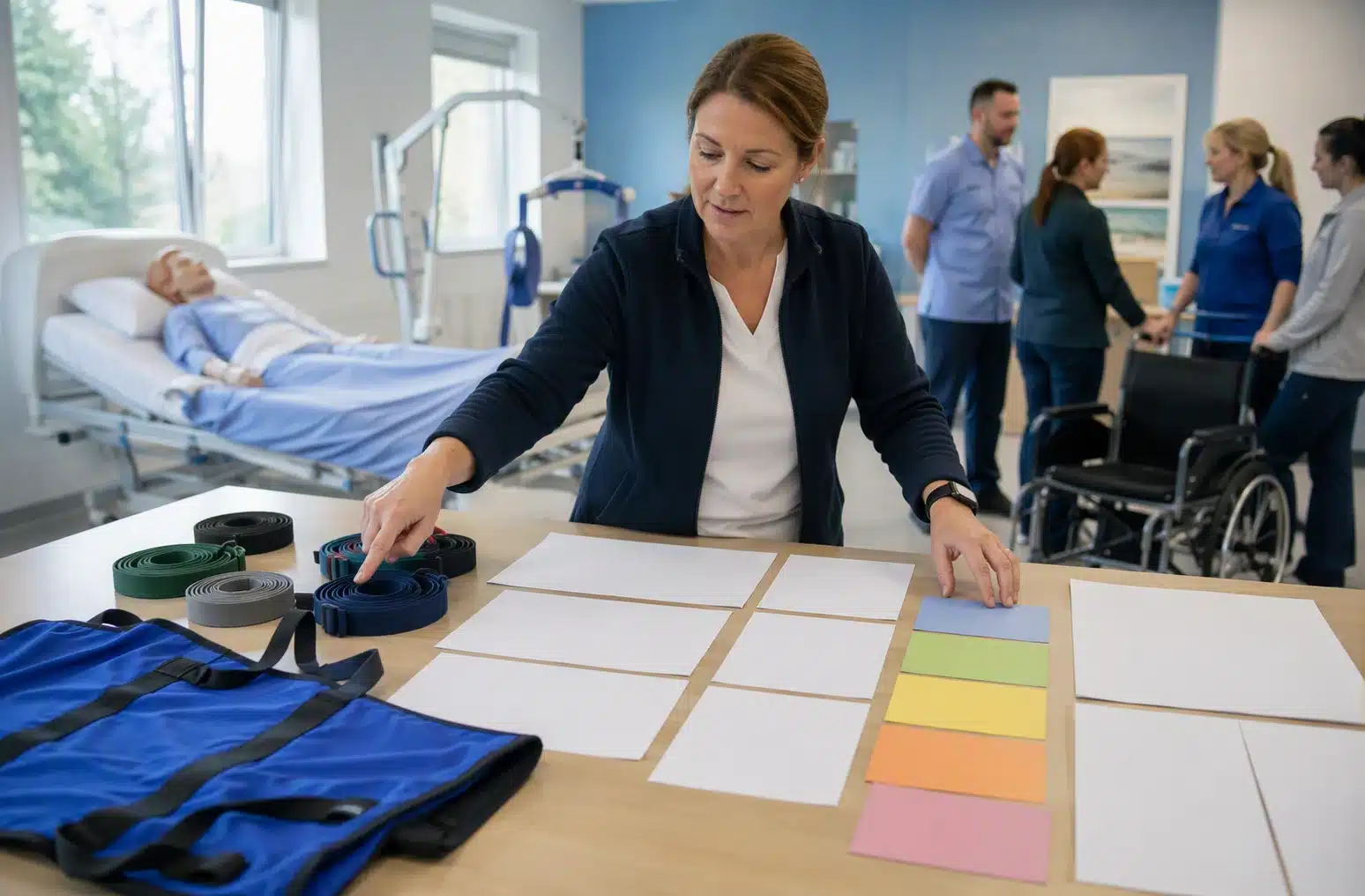
A good course plan gives staff time to watch, try, ask questions, and correct technique.
Day Three: Demonstration, Presentation, and Examination
The final day tests whether you can deliver training safely and with confidence. You complete practical demonstrations, present course content, and take the required examination elements.
Expect to show that you can:
- Prepare the learning space and equipment
- Demonstrate safe methods step by step
- Observe learners and give useful feedback
- Deal with unsafe practice quickly and calmly
- Keep training records and follow workplace controls
Treat the assessment like a real staff session. Clear instructions, safe setup, and calm coaching matter as much as technical knowledge.
How the People Handling Instructor Course Is Assessed
Skills Demonstration: Show Safe, Adaptable Practice
The practical assessment carries the most weight. You must demonstrate safe people handling techniques and show that you can teach them clearly to others.
Expect to assess a task, choose suitable equipment, explain controls, and adapt your approach to the person and setting. Clear cues, safe posture, and checking learner understanding all matter.

Tip: Talk through your decisions as you work. An assessor needs to see your judgement, not only the final movement.
| Assessment element | Weighting | What it tests |
|---|---|---|
| Skills demonstration | 60% | Safe technique, instruction, risk awareness |
| Theory exam | 20% | Knowledge of principles, law, and safe practice |
| Risk-assessment assignment | 20% | Ability to identify hazards and plan controls |
Theory Examination and Risk-Assessment Assignment
The written elements test whether you understand the reasons behind the practice. The theory exam is worth 20%, while the assignment is worth 20%.
The QQI component specification sets out this 60/20/20 assessment model. Your assignment should identify hazards, assess risk, and propose realistic controls for a handling task.
- Read the brief closely.
- Use workplace-based examples.
- Link each control to the risk it reduces.
What It Means to Pass
You need to meet the required standard in every assessment element. A strong practical result cannot make up for an incomplete assignment or failed theory exam.
Guardian Safety’s course prepares you for the full People Handling Instruction award, which combines two QQI components at NFQ Level 6, as listed by QQI.
Also Read: Abrasive Wheels Testimonials
Can You Deliver People Handling Training After the Course?
What the Qualification Enables You to Do
Once you achieve the QQI Level 6 People Handling Instruction award through Guardian Safety, you can deliver workplace people handling training in-house. The HSA states that workplace training may be delivered by either an external or in-house QQI Level 6 instructor.
You can:
- Plan sessions around real care tasks and equipment.
- Teach safer transfer, support and mobility methods.
- Assess learner understanding and practical skill.
- Keep attendance, assessment and training records.
HSA guidance also confirms that Level 6 awards are managed by QQI.
Use your course materials as a base, then tailor practice to your own setting and service users.
What the Qualification Does Not Mean
The award does not remove your employer’s wider safety duties. Training alone cannot make an unsafe task safe.
You still need to:
- Check each task, person, environment and aid.
- Follow local care plans and moving-and-handling policies.
- Stop training where a learner lacks skill or confidence.
- Keep your knowledge current through CPD.
The HSA stresses that employers should avoid or reduce handling risk, not rely on training alone. Training must fit the actual work task.
Build Confidence and Maintain Instructor Competence
Use Guardian Safety’s Resources to Plan Your First Session
Start with Guardian Safety’s course materials, then tailor examples to your ward, home, or service.
- Review the lesson plan and learner handouts.
- Check equipment and space before the session.
- Build practice around real transfer tasks.
Keep training task-specific. The HSA says training alone does not remove risk, so link each technique to local controls and equipment.
| First-session focus | What to prepare |
|---|---|
| Learner needs | Common people handling tasks |
| Practical work | Safe space and suitable aids |
Keep Skills Current Through Review
Ask learners what felt unclear. Observe practice and update your notes after each course.
Ready to train staff safely and meet workplace needs? Book your People Handling Instructor course with Guardian Safety and build the skills to deliver confident, compliant in-house training.
Frequently Asked Questions
Q1: Can I deliver People Handling training after completing Guardian Safety’s 3-day course?
Yes, once you meet the course requirements and pass all assessments, you can deliver in-house people handling training within your skills, workplace policies, and insurance arrangements.
Q2: How is the People Handling Instructor course assessed by QQI and Guardian Safety?
Assessment includes written work, practical skills, and a training delivery assessment. You must show safe handling knowledge, clear instruction, and be able to correct learners.
Q3: Do I need healthcare experience?
Healthcare or care-sector experience helps. You also need sound people handling skills and confidence working with groups.
Q4: What resources can I use after the course?
Guardian Safety provides course materials that support planning, delivering, and recording in-house training.
Conclusion
A qualified people handling instructor needs more than safe lifting skills. You must assess risks, plan clear sessions, demonstrate sound practice, and check that learners can apply it at work.
Guardian Safety’s course structure gives you practical teaching experience, assessment clarity, and resources to support in-house delivery. Keep training tied to real tasks, equipment, and each person’s needs.
The case for strong instruction is clear. The HSA reports that manual handling caused 227 reported health and social care incidents in 2023. A QQI Level 6 instructor can train in-house, but ongoing training remains vital to maintain competence.